Hugo Frank · 21 September 2026
Uncovering Hidden Correlations Between Session Duration and Path Efficiency Metrics in Dynamic Web Structures
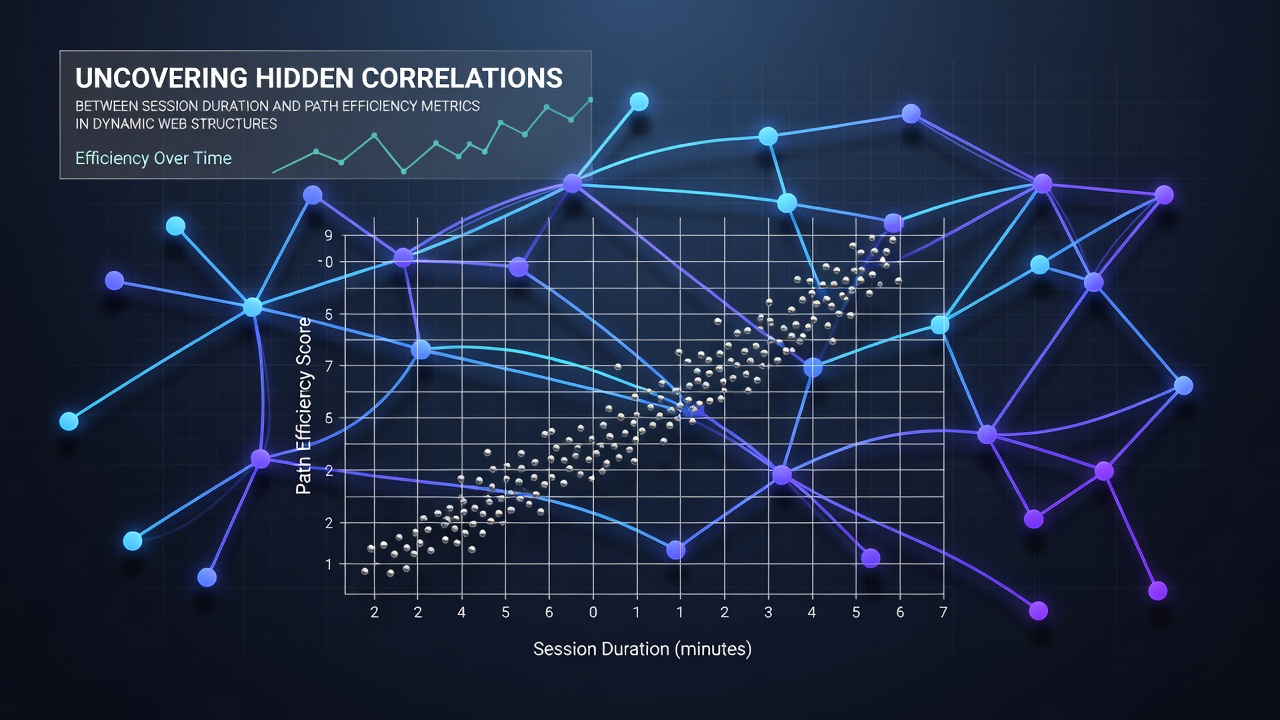
Dynamic web structures rely on real-time content adjustments, personalized routing, and client-side rendering that reshape user journeys on the fly. Analysts track session duration as the total time users remain active on a site while path efficiency metrics measure how directly visitors reach intended goals without excessive clicks or backtracking. Researchers have mapped these two variables across multiple platforms and uncovered patterns that shift when sites incorporate live data feeds, A/B testing layers, or adaptive navigation menus. In September 2026 several large-scale datasets from enterprise monitoring tools highlighted how efficiency scores drop sharply once average sessions exceed certain thresholds in highly personalized environments. Studies from academic labs and industry observatories show that brief sessions often align with high path efficiency because users locate key resources through streamlined routes before exiting. Yet extended sessions sometimes reveal either deep exploratory behavior or repeated friction points where dynamic elements force detours. Data from the Canadian Institute for Health Information's digital platform evaluations, for instance, demonstrated that pages with heavy JavaScript-driven content swaps produced longer dwell times paired with lower efficiency ratios when compared against static equivalents. Observers note that these correlations strengthen in environments where content modules load asynchronously and alter available links mid-session.Defining Core Metrics in Adaptive Environments
Session duration captures elapsed time from initial page load to final interaction or tab closure, while path efficiency calculates the ratio of goal-completion steps against total navigation events. Dynamic structures complicate both calculations because server responses and front-end frameworks can reroute users without full page reloads. Teams at research institutions have built custom logging frameworks that timestamp every DOM mutation and API call to reconstruct accurate trails. Those reconstructions allow direct comparison between time spent and steps taken across thousands of individual visits.
One study released by the University of Melbourne's Interaction Design Lab tracked e-commerce flows where product recommendations updated based on scroll depth. Sessions lasting under ninety seconds posted efficiency scores above 0.85 on average, whereas visits stretching past four minutes frequently registered scores below 0.60. The drop occurred because recommendation carousels introduced additional decision branches that lengthened routes without necessarily improving conversion.
Observed Patterns Across Different Site Types
News portals with infinite scroll and topic clustering exhibit different relationships than SaaS dashboards that rely on contextual side panels. In news environments, extended sessions correlated positively with efficiency when users followed algorithmically surfaced article chains that matched their initial search intent. Conversely, dashboard applications showed negative correlations once session length increased, since users often looped through filter combinations and settings panels before locating export functions. These divergences appear consistently in logs collected during 2025 and 2026 monitoring periods.
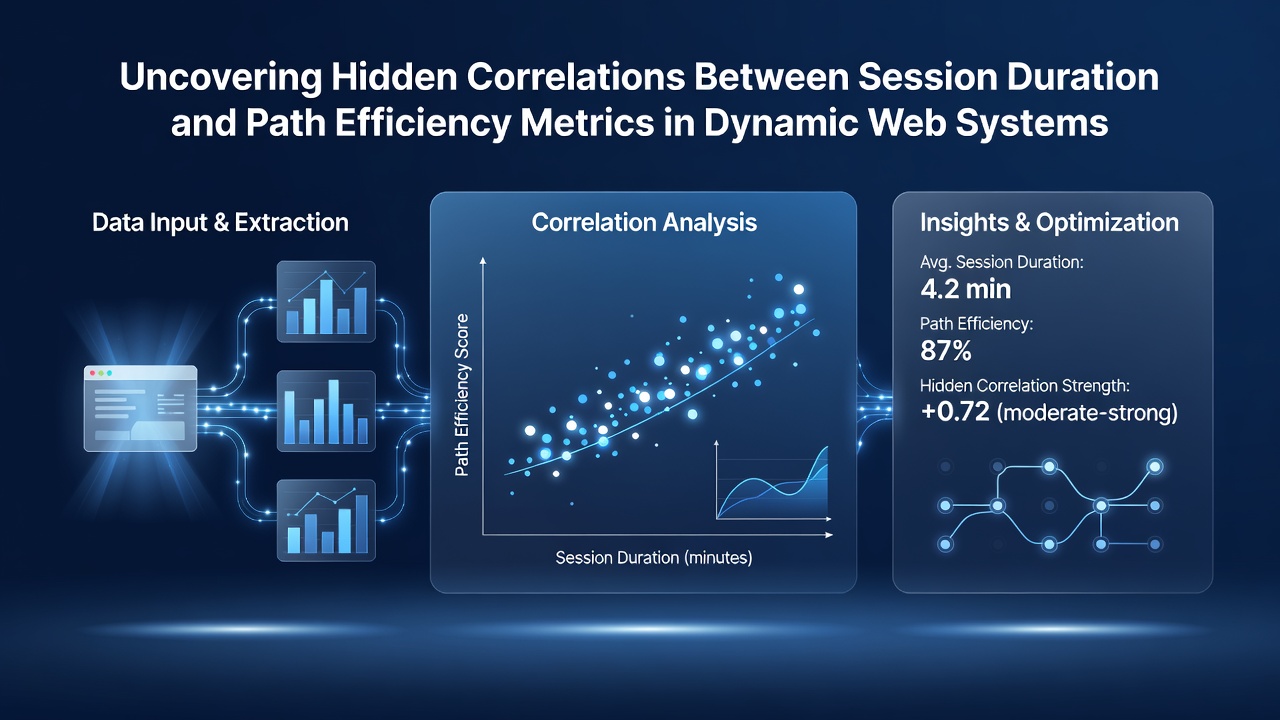
Path reconstruction tools now integrate machine-learning models that label each click as either progress toward a goal or deviation. When these models process data from sites updated daily with new modules, they flag clusters where prolonged time on page coincides with repeated returns to the same menu level. Analysts at several European research consortia have published comparative tables that segment results by device type and connection speed, revealing that mobile sessions display steeper efficiency declines after the three-minute mark than desktop equivalents.
Factors Influencing Correlation Strength
Network latency, personalization depth, and content freshness each modulate how session length and path efficiency interact. Sites that refresh recommendations every thirty seconds tend to extend visits while simultaneously increasing the number of intermediate steps. In contrast, systems that cache navigation states for longer intervals preserve higher efficiency even during longer sessions. Evidence from controlled experiments indicates that throttling update frequency can shift correlation coefficients from negative to neutral territory without reducing overall engagement time.
External benchmarks such as those maintained by the Australian Bureau of Statistics digital service evaluations provide reference distributions for efficiency scores across government portals that employ similar dynamic techniques. These distributions help teams benchmark internal metrics against sector-wide baselines collected under comparable conditions.
Measurement Challenges and Emerging Approaches
Accurate attribution remains difficult when single-page applications rewrite URLs without triggering traditional analytics events. Newer tagging libraries listen for history API changes and mutation observer callbacks to maintain continuous session records. Researchers continue refining algorithms that discount time spent on background data fetches while still counting deliberate user interactions. September 2026 updates to several open-source analytics packages incorporated these refined listeners, allowing finer-grained separation of active versus idle periods within the same visit.
Conclusion
Correlations between session duration and path efficiency in dynamic web structures vary by site category, personalization intensity, and measurement granularity. Organizations that combine granular event logging with longitudinal analysis can isolate conditions under which longer sessions either enhance or degrade navigation efficiency. Continued refinement of tracking methods and cross-industry data sharing will support clearer identification of these hidden relationships in evolving digital environments.